Argentina
Since October 9, 2025
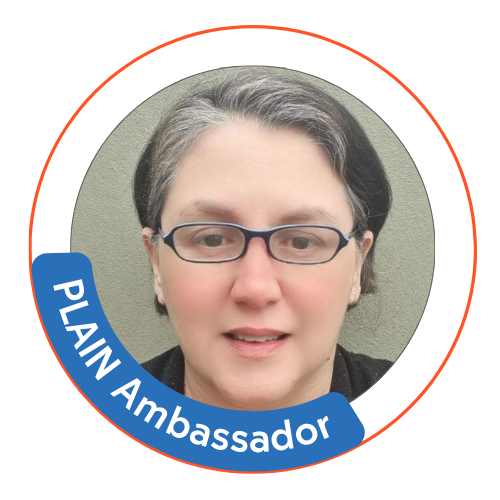
PLAIN Ambassador
Valeria Magali Colella
What first inspired you to get involved with plain language?
My interest in plain language grew out of my work as a text editor and communicator in legal settings. I often observed that people struggled to understand information that directly affected their rights, obligations, or access to services. This gap between those who produce information and those who receive it led me to explore strategies for communicating in a clearer, more accessible, and more effective way.
How did you become a plain language ambassador?
My involvement in the plain language movement developed naturally through teaching, research, and institutional work. I have had the opportunity to teach in the first Diplomatura Universitaria en Lenguaje Claro at Universidad del Salvador, as well as in activities organized by professional associations, national and international organizations, and various public institutions.
When I became familiar with PLAIN’s work, I found an international community whose values and goals closely aligned with my professional experience. I was therefore delighted to take on the role of ambassador.
Why is plain language important to you personally or professionally?
I believe that understanding information is essential for exercising rights, making informed decisions, and participating fully in democratic life. From a professional perspective, plain language improves the effectiveness of communication and strengthens the relationship between institutions and the people they serve. On a personal level, it reflects a commitment to inclusion, transparency, and respect for those who receive our messages.
Can you describe a project where plain language made a real difference?
One of the most significant projects I have been involved in was my work as a plain language advisor for the Programa de Lenguaje Claro of the Gobierno de la Ciudad Autónoma de Buenos Aires. There, we worked on multiple fronts: conducting institutional communication assessments, redesigning and prototyping citizen-facing documents, delivering training programs for staff, and contributing to the development of an artificial intelligence tool designed to clarify texts.
What was particularly interesting was seeing how plain language could be integrated into a wide range of processes, from document production to the adoption of new technologies. We also expanded this work to other public institutions by providing training and advisory services to public officials and members of the judiciary, as well as to the Poder Legislativo de Córdoba. In a way, this allowed us to work across all three branches of government and demonstrate that clear communication is a cross-cutting need, regardless of the role of a particular institution.
We also collaborated with the telehealth department of Hospital Cecilia Grierson, where we applied plain language principles to improve communication mediated by digital technologies between healthcare teams and service users.
What’s your process for simplifying a complex text?
The first step is identifying the intended audience and determining what they need to understand or do with the information. I then analyze the structure of the text, identify its key messages, and remove redundant or less relevant content. Next, I reorganize the information into a logical sequence, use more familiar vocabulary whenever possible, and rewrite sentences to make them more direct.
Finally, I review design, accessibility, and usability aspects, and whenever possible, I validate the result with real users or people who are representative of the target audience.