Belgium
Since November 17, 2025
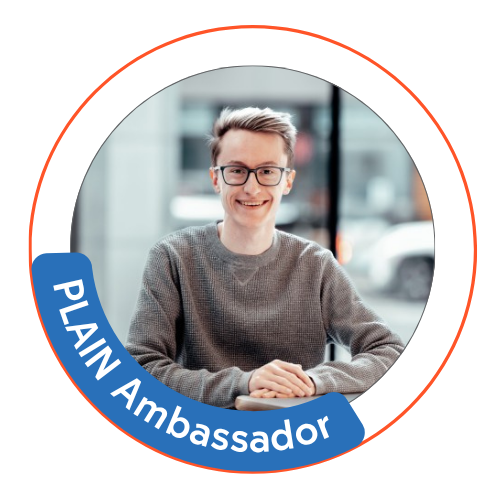
PLAIN Ambassador
Wout Huygens
What first inspired you to get involved with plain language?
I remember back in high school and later at university that I was always annoyed when teachers used sentences that were written to be difficult. As a language nerd, I used to rephrase these sentences in my own words. Aside from being a good way to study, it also made me aware that texts can restrict people’s access to public services such as education. In my academic research, I have always focused on this link between language and accessibility. When my PhD proposal on plain language in Brussels’ public transportation sector got accepted, I was very happy to start working full-time on the promotion of plain language in Belgium.
How did you become a plain language ambassador?
After attending the Brussels Plain Language Experience in 2025, I realized that I wanted to do more for the Belgian plain language movement next to my research. As an ambassador, I would be able to bring attention to the complex, multilingual reality of Belgium. As I fluently speak the 3 official languages of Belgium, Dutch, French and German, my goal is to bring together the Belgian plain language movement from all languages.
Why is plain language important to you personally or professionally?
As a neurodivergent person, I hate it when instructions do not explicitly describe all steps of a process. For example: the city hall asks you to bring a photo for a new identity card. They say that you need a photo on a white background but forget to mention it should be a passport photo printed on photo paper. In this case, it would be useful to explain in more detail how and where you should obtain this photo. Plain language editing does not always mean using fewer words, sometimes it can be the opposite.